The Best One Week in Split, Croatia Itinerary
- Daphne Pearson
- Jul 9
- 7 min read

Looking for the ultimate one week in Split itinerary? If you want to really settle into one Croatian base instead of packing and unpacking every night, Split is one of the best cities in the country to do it from.
It’s got a genuinely stunning Old Town built right into the walls of a Roman palace, a lively waterfront, great beaches minutes from the center, and — this is the real draw — it sits at the crossroads of the Dalmatian Coast. Islands, waterfalls, canyons, and medieval towns are all within an hour or two, so you can sleep in the same bed all week and still see an enormous amount of Croatia.
Here’s the perfect one week in Split itinerary for your trip!
Notes on Where to Stay
You’ll be based in Split’s Old Town or just outside it for the whole week, so it’s worth spending a little more here than you would for a one-night stopover elsewhere.
Staying inside or right against the walls of Diocletian’s Palace means you can walk to almost everything, but it also means noise from bars and restaurants late into the night, especially in summer. If you’d rather have some quiet, look at the Varoš or Veli Varoš neighborhoods just west of the Old Town, or the area around Bačvice Beach to the east.
Airbnb has an excellent selection in Split too, often in apartments with balconies and sea glimpses for less than a comparable hotel room, so it’s worth comparing both.

Day 1: Arrive and Explore Diocletian’s Palace
However you’re arriving — flying into Split Airport, taking the train down from Zagreb, or the ferry in from Ancona in Italy — plan to land with enough daylight left to get your first look at the Old Town.
Diocletian’s Palace isn’t a museum you walk through and leave; it’s a living neighborhood. The Roman emperor built it as his retirement complex in the fourth century AD, and over the last 1,700 years locals have built homes, shops, cafes, and even a cathedral directly into and on top of the original walls. Wandering the maze of narrow marble streets, with laundry hanging overhead and a wine bar tucked into a Roman corridor, is one of the most atmospheric things you’ll do all week.

Start at the Riva, Split’s palm-lined waterfront promenade, then head in through the Bronze Gate into the palace’s cellars — cool, cavernous, and worth exploring even though they’re largely empty now. Climb up into the Peristyle, the palace’s central square, where you’ll usually find someone busking or a costumed “Roman soldier” posing for photos. Duck into the Cathedral of St. Domnius, originally built as Diocletian’s mausoleum, and climb its bell tower if you’re up for the narrow spiral stairs — the view over the terracotta rooftops is worth it.
In the evening, get dinner at one of the restaurants tucked into the palace walls or along the Riva, and just enjoy the buzz of people-watching as the city cools down.
Day 2: Marjan Hill and the Rest of Split
Today, slow down and see the rest of the city beyond the palace walls.
In the morning, walk or hike up Marjan Hill, the forested peninsula that rises just west of the Old Town. There are several viewpoints along the way, but Vidilica is the classic one — a small cafe terrace with sweeping views back over Split’s rooftops and out to the islands. It’s a fairly easy walk, but wear real shoes; parts of the path are uneven stone steps.
Coming back down, wander through Veli Varoš, the old fishermen’s quarter on the hill’s lower slopes, with its stone houses and quiet lanes — a nice contrast to the crowds inside the palace.
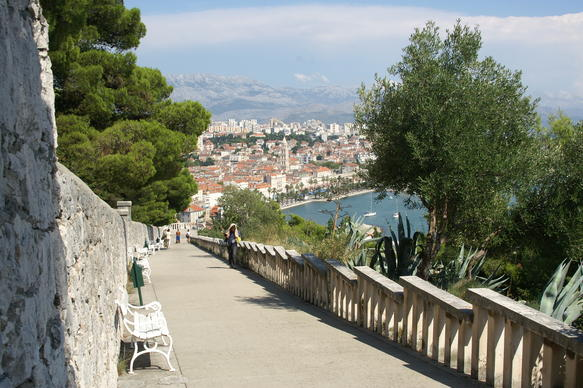
In the afternoon, head to Bačvice Beach, Split’s most popular city beach, just a short walk from the Old Town. It’s a sandy cove (rare on this rocky coast) and the unofficial home of picigin, a local beach game played in shallow water that you’ll see groups of friends playing for hours. Beyond Bačvice, Kašjuni is a quieter pebble beach on the Marjan side worth the extra walk if you want fewer crowds.
Round out the day with dinner somewhere off the main tourist strip — the streets around the fish and vegetable market (Pazar and Ribarnica) have some excellent, less touristy konobas (traditional taverns).
Day 3: Krka National Park
Today is your first day trip, and it’s an easy one: Krka National Park is just over an hour from Split.
Krka is smaller and generally less crowded than Croatia’s more famous Plitvice Lakes, and it has one big advantage — you’re allowed to swim in parts of it. The main circuit is a boardwalk loop through a series of travertine islands and cascades, ending at Skradinski Buk, the park’s largest and most photogenic waterfall, a broad staircase of falling water dropping into a wide pool.

Entering through Skradin gets you a scenic boat ride down the river as part of your ticket, which is the nicer way to arrive if you have the choice. If you don’t have a rental car, there are direct organized day trips from Split that include transport, and it’s an easy one to do without a tour if you’re comfortable with local buses.
Plan for a half to full day here — the boardwalk loop itself only takes an hour or so, but you’ll want time to swim and relax by the falls.
Day 4: Hvar and the Blue Lagoon
Today, leave the mainland behind for one of Croatia’s best-loved islands.
Hvar is famous for two very different things: a glossy, see-and-be-seen harbor town with a hilltop fortress and the largest square in Dalmatia, and a genuinely beautiful, lavender-scented interior of vineyards and stone villages. You can reach Hvar Town on your own by catamaran in about an hour, but the most popular way to do it — and the way to also see the Blue Lagoon and a couple of smaller islands in the same day — is on an organized speedboat tour.

A typical full-day boat trip from Split will stop at the Blue Lagoon near the islet of Šolta or Drvenik for swimming in improbably turquoise, shallow water, continue on to explore Hvar Town for a couple of hours, and often include a stop at one more island along the way. If you’d rather have more unhurried time in Hvar Town itself — climbing up to the Fortica fortress for the view, or just lingering over lunch on the harbor — take the catamaran independently instead and skip the group tour.
Either way, book ahead in peak summer months, since both the ferries and the popular boat tours fill up fast.
Day 5: Trogir and Klis Fortress
Today’s trip stays closer to home and mixes two very different kinds of history, and it works well as a half-day so you can also relax back in Split in the afternoon.
Trogir is a tiny, UNESCO-listed medieval town built on its own small island, connected to the mainland by a bridge, about 30 minutes from Split. Its stone streets and Romanesque cathedral feel a little like a miniature, quieter version of Split’s Old Town — it’s an easy, pleasant few hours of wandering, with plenty of waterfront cafes for a coffee break.
On the way back, stop at Klis Fortress, perched dramatically on a rocky ridge overlooking the pass into Split. Game of Thrones fans will recognize it as the setting for the fictional city of Meereen, but it’s worth a visit regardless — the fortress has guarded this same strategic gap in the mountains since Roman times, and the views down over Split and the islands from the ramparts are terrific.

Both are easy to combine into one trip if you have a car, or you can book a short organized tour that covers both.
Day 6: Adventure Day — Omiš or Biokovo
Save today for something more active, and pick based on what sounds like more fun to you.
Omiš, about 40 minutes south of Split, sits where the Cetina River carves a dramatic canyon down through the mountains to meet the sea. It’s the base for whitewater rafting and canyoning trips along the river, surrounded by cliffs and forest, and the small town itself has two hilltop fortresses worth the climb for pirates-and-fortifications history (Omiš was a notorious pirate stronghold in the Middle Ages).
Alternatively, head further south to Biokovo Nature Park above the resort town of Makarska. The road up the mountain is one of the most scenic drives in Croatia, climbing to a cliffside skywalk platform more than 1,200 meters above the coast, with views stretching out over dozens of islands on a clear day. Pair it with lunch in Makarska itself, a laid-back beach town with mountains rising almost straight up behind it.
Both make for a satisfying, slightly more adrenaline-filled change of pace after a week of ruins and islands.
Day 7: Last Day in Split
Save your final full day for whatever you didn’t get to, plus one thing worth doing at least once: sunset from the water.
If you haven’t already, this is a good day to browse Split’s markets — the green market (Pazar) for produce and souvenirs, and the fish market (Ribarnica) for a look at the local catch, famously odorless thanks to a natural sulfur spring nearby that keeps the flies away. It’s also worth ducking into the Meštrović Gallery if you like sculpture; it’s a short walk or bus ride from downtown and much less crowded than anything inside the palace walls.
In the evening, book a short sunset boat cruise along the coast, or simply find a spot on the Riva or up on Marjan Hill and watch the sun go down over the islands — it’s one of the best free shows in Croatia.
Finish with a final dinner somewhere with a view, and toast to a week well spent.
Day 8: Leave
Depart from Split. If you’re catching a flight, the airport is about 25 minutes from the city center by taxi or shuttle bus.
And that’s a wrap on your one week in Split!
Other Important Things to Know
Croatian is the official language, but English is widely spoken, especially in tourist areas.
Croatia uses the euro.
Renting a car makes the day trips to Krka, Trogir, Klis, Omiš, and Biokovo far more flexible, but parking inside or near the Old Town in Split is limited and best avoided — park in one of the paid lots just outside the walls instead.
For the islands, book ferries and boat tours in advance during July and August, when everything sells out early.
High season is June through September, when both crowds and prices peak. Late May and September offer warm weather with noticeably fewer people.
Many island and coastal businesses close down for the winter, so November through March is not the best time for this itinerary.


Comments